The Three Processes Behind Every Successful Project
Preliminary, Decision, and Building
Every project may look different on the surface, but behind every successful outcome lies the same structure.
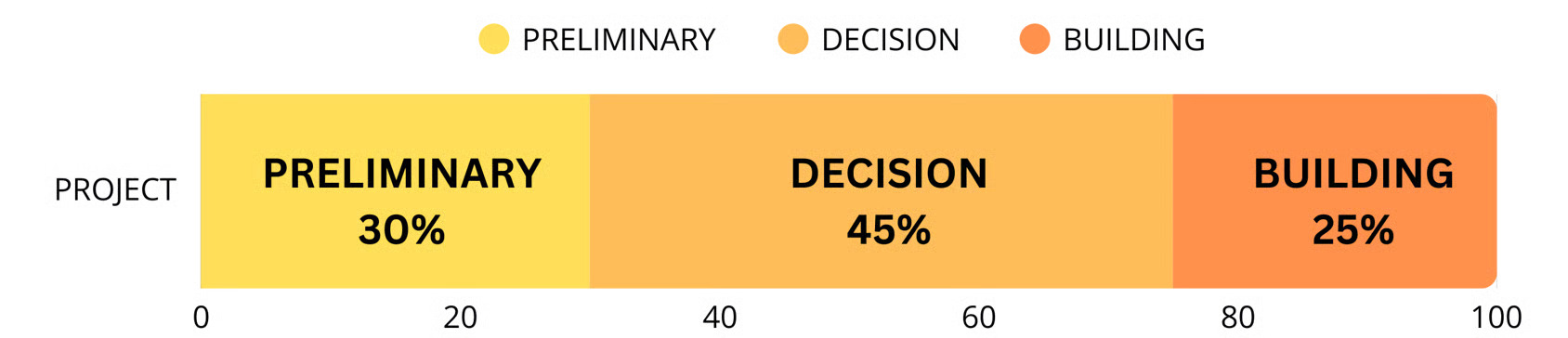
From our experience, a project’s success is shaped by three essential processes that together account for 100% of its outcome:
- Preliminary Process — 30%
- Decision Process — 45%
- Building Process — 25%
Interestingly, the Building Process often receives the most blame when problems occur — even though it contributes only a quarter of the final result.
Most project challenges begin long before construction starts.
Preliminary Process (30%)
Creating Direction Before Execution
The Preliminary Process establishes the foundation of the project. It is where uncertainty is reduced and direction begins to take form.
This stage focuses on understanding before acting.
Concept Development
Ideas are explored and translated into a clear project intention. Goals, lifestyle needs, and practical constraints are discussed to define a shared vision.
Feasibility Evaluation
We assess whether ambitions align with reality — technically, financially, and operationally. The objective is not to limit creativity, but to ensure it can be executed successfully.
Design Structuring and Detailing
Concepts evolve into structured plans and specifications that guide future decisions. Clarity at this stage prevents confusion later.
Material Direction
Material strategies are introduced early, particularly finishing considerations that influence cost, sequencing, and long-term performance.
The Preliminary Process aligns expectations and reduces future uncertainty.
It prepares the project to move forward with confidence rather than assumption.
Decision Process (45%)
The Core of Project Success
The Decision Process is the most influential phase of the project lifecycle.
This is where information becomes commitment.
While many projects rush toward construction, we focus on stabilizing decisions first — because execution can only be as strong as the clarity behind it.
Structured Collaboration
Discussions are guided to ensure alignment between stakeholders. Communication becomes purposeful rather than reactive.
Understanding Needs vs. Wants
Project owners often balance aspiration with practicality. Our role is to clarify priorities so decisions reflect both intention and feasibility.
Expectation Alignment
Goals, budgets, and timelines are refined through transparent evaluation. Alignment reduces future conflict.
Decision Locking
Design directions, material selections, financial considerations, and sequencing strategies are finalized. Each decision becomes a stable reference for execution.
The Decision Process transforms ideas into actionable certainty.
It is where the project gains its true direction.
Building Process (25%)
Executing What Has Already Been Decided
The Building Process is where plans become physical reality.
Although highly visible, this phase represents the outcome of earlier thinking rather than the beginning of it.
Execution
Construction progresses according to established scope and approved decisions.
Monitoring and Adjustment
Progress is evaluated against agreed direction. Adjustments are carefully assessed to prevent disruption to sequencing and finishing integrity.
Quality Assurance
Together with Pakde Slamet and the project team, we ensure execution reflects the intended standards and detailing defined earlier.
When the Preliminary and Decision Processes are strong, construction becomes smoother, more predictable, and less reactive.
Why Understanding These Three Processes Matters
Projects rarely fail because construction teams lack skill.
They struggle when:
- direction is unclear,
- decisions remain unresolved,
- or expectations shift during execution.
By recognizing the distinct role of each process, projects move from uncertainty toward controlled progress.
A Different Perspective on Project Management
Project management is often seen as coordinating tasks.
We see it as guiding clarity.
Our responsibility is to ensure that every stage — from early thinking to final execution — remains aligned with the project’s purpose and finishing integrity.
Because successful projects are not defined by how quickly they are built,
but by how clearly they are understood before they begin.
Let’s build with intention — from decision to completion.